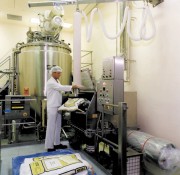
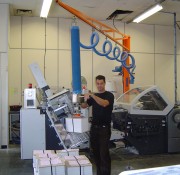
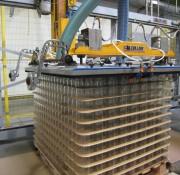
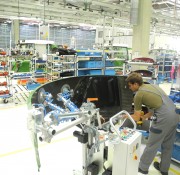
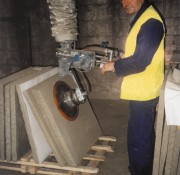
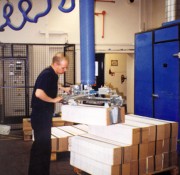
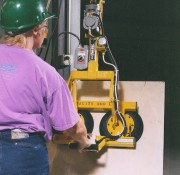
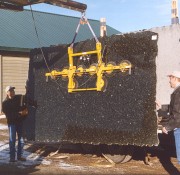
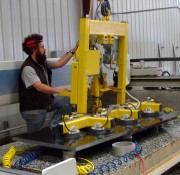
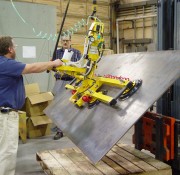
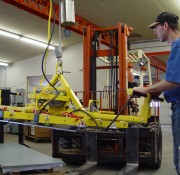
Vacuum lift tube technology differs from
conventional vacuum gripping tools by combining lifting and gripping in
one simple, safe system requiring no special interlocks or special
safety devices.
Vacuum, or the presence of lower than
ambient air pressure, creates a powerful holding force against porous or
nonporous surfaces. The larger the contact area and the greater
the vacuum pressure, the higher the holding force. Properly
designed vacuum tools can be used to lift or hold many tons.
Vacuum is powerful when correctly applied.
Flow is equally important. Vacuum
without a high flow rate when applied to porous surfaces such as
cardboard is not a very powerful force. But as flow and surface
area increases the force increases. With proper design, vacuum can
be used to hold or lift almost anything.
Vacuum Lifting
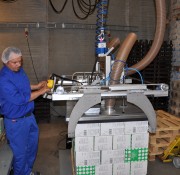
Palamatic lift tube systems use vacuum
and flow to both lift and hold payloads. The use of a hoist is not
required.
Using vacuum lift tube technology to lift
as well as hold requires design within an optimum range of flow, contact
area, vacuum pressure and lift tube diameter. This is why
Palamatic offers three separate and distinct ranges of lift tube
products:
- The ML or Mini Lift series for
payloads 100 pounds or less
- The PL or Pal-U-Lift series for
payloads from 50 to over 200 pounds
- The HCL or High Capacity Lift series
for payloads from 200 to over 1,000 pounds

Lifter capacities within each series are
dependent on tooling weight, payload porosity, available surface area
for vacuum cups and the diameter of the lift tube or tubes.
Lift Tube Productivity
Vacuum lift tubes are well suited to
delicate component as well as rugged containerized payloads.
Vacuum cups require a good seal to be effective and by their very nature
are soft, compliant and non-marking.
Tooling can be designed to include
powered or manual functions for pitching, turning or rotating payloads
for optimum positioning. Tooling can also be designed to handle
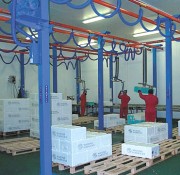
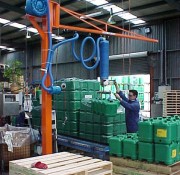
multiple payloads in one lift.
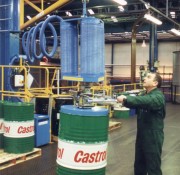
Palamatic also offers quick change
tooling that can covert a lifter from one application to another in 30
seconds or less. Thus, for example, the same lifter could be used
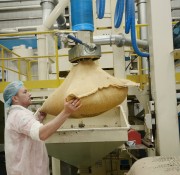
to handle bags and drums in the same work area.
Operators controls can be designed to
extend the operator's vertical or horizontal reach, thus improving work
area mobility, allowing reach across pallets or conveyors, increasing
range of motion and ergonomic working postures. Palamatic's range
of operator's control options are the widest available.
Unlike hoists, lift tubes are 100% duty
cycle lifting devices with infinitely variable speed lifting and
positioning. At optimally designed work stations operators can
handle 5 or more payloads per minute with minimal physical exertion and
fatigue.
Lift Tube Safety
Palamatic systems are designed to insure
that more than twice the gripping force is available versus the payload
weight, a minimum 2 to 1 safety factor. The same vacuum flow is
used for gripping as well as lifting. Thus, if the gripping force
cannot be generated, such as on a cardboard box with a tear or hole in
the box, the load cannot be lifted.
In the event of a power failure, a built
in vacuum safety valve enables the vacuum lifter to automatically lower
the payload to the floor in a safe and controlled manner.
Lift Tube Versatility
Simply put, vacuum lift tube technology
can be applied to all manner of handling situations where varying
payloads need to be moved quickly and efficiently.
Palamatic Handling has a lifting solution
for your application. We are looking forward to working with you
to improve the quality, safety and productivity of your handling
requirements.
Top